
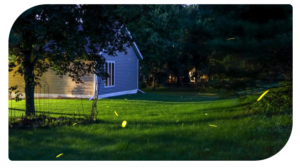
 When I was a child, summer nights seemed alive with light — not the harsh glare of streetlamps or porch bulbs, but a living, breathing shimmer that drifted through the warm air. We called them lightning bugs, though some called them fireflies. They were just as much a part of summer as the hum of crickets or the smell of freshly cut grass.
As the sun set and the first stars appeared, fields and backyards began to sparkle—tiny lanterns rising from the grass, blinking in a gentle rhythm, as if the earth itself were exhaling light. We’d run barefoot through the yard, laughing and chasing that slow, teasing flash that always seemed just out of reach.
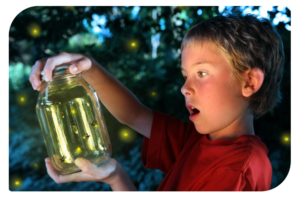
I remember softly cupping one in my hands, looking between my fingers at the tiny green pulse glowing inside. It felt like holding a secret — a heartbeat of the night.
We’d carefully place them in glass jars, punching holes in the lids so they could breathe, and set them beside our beds. The room would fill with a soft, blinking glow — a small piece of the outside world we could keep, even if only for a night.
And always, before we went to sleep, we let them go because we knew the night belonged to them.
 How the Light Happens
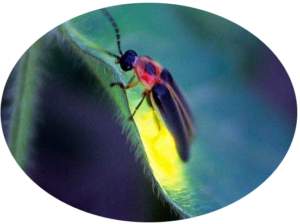
For years, I believed lightning bugs created magic — that their glow was something mysterious and beyond understanding. It wasn’t until I reached adulthood that I learned they’re not flies at all but soft-bodied beetles belonging to a family called Lampyridae. The name comes from the Greek word lampein — “to shine.”
That shine is pure chemistry, even though it feels like poetry. Inside each firefly’s tiny lantern—a special organ in its tail—a compound called luciferin reacts with oxygen and other ingredients to produce light without heat. Nearly 100 percent of the energy turns into light; nothing is wasted. It’s the most efficient light on Earth.
Each species has its own rhythm — a kind of Morse code for love. One flashes twice and then pauses, another sends three quick sparks in a row. The males send the message; the females respond. Sometimes, a predator joins in — a “femme fatale” firefly mimics the signal to attract prey instead of a mate.
There’s even a kind that flashes together in perfect unison, lighting up entire forests at once like a living constellation. But here, in my corner of the world, they blink at their own slow, deliberate pace, like tiny heartbeats pulsing in the dark.
The Vanishing Glow
Lately, the nights here are quieter — and darker in a way they were never meant to be. The air still hums with crickets, and the heat still lingers after sunset, but the sparkle is gone. I can step outside in midsummer now and maybe see one or two faint flashes at the edge of the yard, where there used to be hundreds rising from the grass like sparks from a campfire.
 It didn’t happen all at once. Streetlights appeared first, then more houses, trimmed lawns, and weeds that were sprayed. The woods bordering the neighborhood were cleared for new developments. The soft, dark space where fireflies once danced is now filled with porch lights that never turn off.
We may be witnessing the end of fireflies here — one of the last generations to drift through our summer nights as living embers. But this isn’t nature’s fault. It’s ours.
Fireflies rely on what we’ve taken away: dark skies, moist ground, and wild edges where tall grass grows. When we pave, mow, and flood the night with artificial light, they lose their habitat. Their tiny signals can’t compete with all the man-made glow produced.
Yet every now and then, I notice one — a single slow blink above the grass — and I pause, waiting for the next. It feels like a small miracle, a reminder that not everything is gone, not yet.
Once, the night belonged to them. Maybe someday, it will be again.