
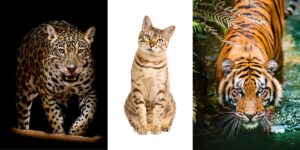
 She’s a pocket-sized tiger—soft paws hiding a hunter’s patience.
The cat sits on the windowsill, her tail lazily tracing figure eights. Outside, a bird flutters — and every muscle in her small body tightens into stillness. She doesn’t move,
but focus hums through her. To her, the glass between them doesn’t matter. The hunter has seen.
It’s easy to forget that the creature curled beside your laptop was once a desert hunter. Her ancestors, Felis silvestris lybica, hunted alone in North African scrublands. They relied on patience, silence, and precision — traits that still exist in today’s housecats. The housecat may nap in warm sunlight, but evolution still observes through those eyes.
We like to see her as domesticated, but she’s really just putting up with civilization — the roommate who keeps her wild passport in the drawer, just in case.
The Evolutionary Echo
Every domestic cat carries a whisper of the wild — a faint desert wind in her genes. Modern cats descended from the African wildcat, a solitary hunter who valued quiet efficiency over teamwork. When humans began storing grain, wild cats came for the mice. They didn’t ask to be tamed; they moved right in next door. Over time, they realized humans provided warmth, steady food, and few threats. In a way, cats domesticated themselves.
Nature perfected the stealthy hunter and never needed to revise its design.
The tiger lives in the rainforest; your tabby stays in the living room. At their core, they are the same: equipped with built-in weapons, radar-like hearing, and the confidence that they are so well engineered they never need updates.
The slow blink, the patient crouch, the lightning-fast pounce — each is an inherited instinct from ancestors who survived by only acting when the odds were in their favor. The “midnight zoomies” that startle us from sleep aren’t madness but training — a predator practicing for the desert she still remembers.
Even her “gifts”—a frog or moth on the rug, a toy carefully placed at your feet—reflect the wildcat’s ritual of sharing a catch. It’s a compliment, really, just not one meant to sit on the coffee table.
Though we shaped dogs, cats shaped themselves. They are evolution’s freelancers: adaptable, precise, and unwilling to conform to any form that demands obedience.
The Unchanged Hunter
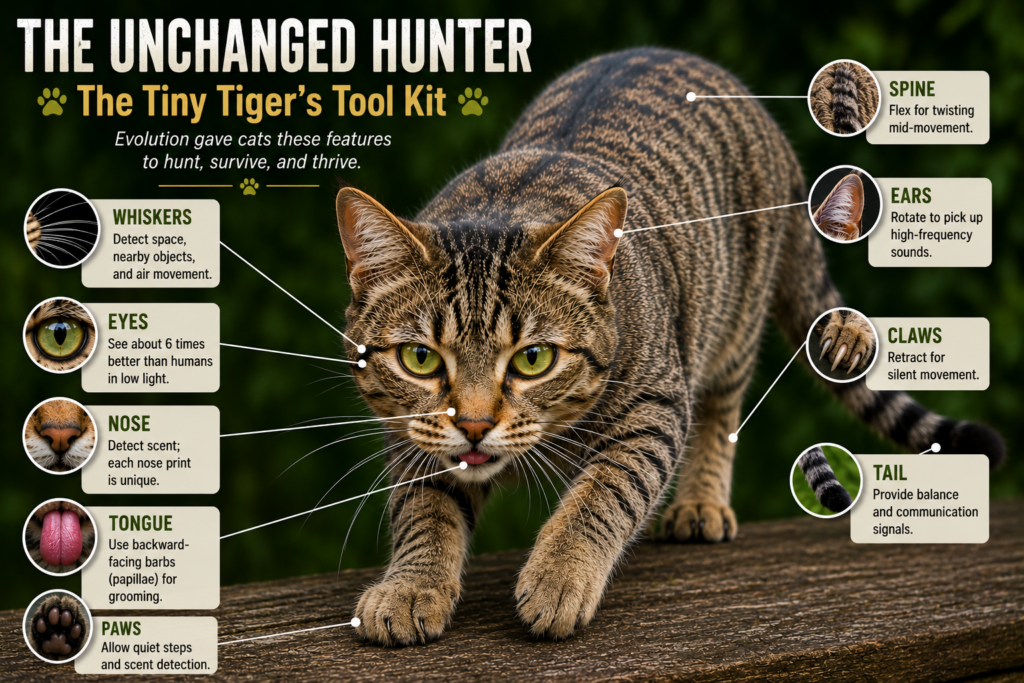
The Domestic Truce
Despite their independence, cats find a peaceful quiet with us — a mutual understanding communicated in silence and fur. We provide warmth, regular meals, and safety. They offer presence: a steady heartbeat on the end of the sofa, a pair of eyes in the doorway, a purr that hums like gentle machinery in the dark. A cat’s purr vibrates between 25 and 150 hertz, a frequency range associated with tissue and bone healing research.
 They don’t live with us; they live alongside us, following their own schedules as they go through our routines. Sharing a home with a cat means accepting a partnership of equals — one where you might be outvoted on blanket rights.
Their affection, when it shows, feels like sunlight breaking through clouds — a slow blink, a brief lean, the curl of a tail around your wrist before sleep.
The Lessons of the Tiny Tiger
Living with a cat reminds us that wildness and comfort can coexist. She sleeps on your pillow but carries the desert within her. Her instincts are still there, not gone. Maybe that’s her quiet lesson — that we, too, can be gentle and fierce, content and untamed.
Cats live their lives unapologetically. They rest when tired, play when curious, and walk away when finished. They don’t seek approval. In their simple, deliberate ways, they demonstrate the confidence we spend years trying to learn.
When the tiny tiger curls up to sleep, the wild and domestic worlds blend — a whisper of the savanna in the hum of home. She has learned to stay, and we have learned to listen. Two species share silence, perfectly at ease.