
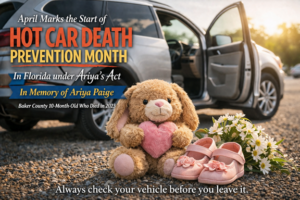
 It happens on ordinary days—a quick stop at the grocery store, a short errand at the pharmacy, with a child or a pet waiting quietly in the car while someone runs inside “just for a minute.”
The parking lot seems calm. The day doesn’t seem very hot. But inside a closed vehicle, the temperature can rise much faster than anyone outside notices.
On a warm Florida day, a parked car can heat up much faster than most people think. It doesn’t have to be a scorching summer afternoon. Even when the temperature is in the 70s, the inside of a vehicle can quickly become hot once the doors are closed and sunlight starts warming the interior.
Researchers have found that the temperature inside a parked car can rise by about 20 degrees in just ten minutes. Heating happens fastest at the beginning. Within thirty minutes, roughly 80 percent of the total heat gain has already occurred. What begins as a pleasant day outside can quickly turn into a dangerous environment inside the vehicle.
Children and Animal Passengers
The risk is especially serious for children and animals. Young children heat up faster than adults, and animals cannot cool themselves effectively in confined spaces.
Heatstroke can begin when body temperature reaches around 104°F, and serious damage can happen quickly if temperatures continue to rise.
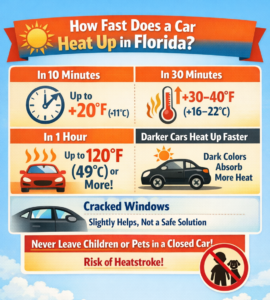 How Fast a Parked Car Heats Up
What surprises many people is how quickly this happens. Studies of parked vehicles show how fast interior temperatures can climb.
- 10 minutes: about 20°F increase
- 30 minutes: roughly 80% of the total heat buildup has already occurred
- 1 hour: interior temperatures may reach 115–120°F or higher
This heating effect happens because sunlight enters through the windows and becomes trapped inside the vehicle, like a greenhouse. Opening the windows slightly does not significantly lower the temperature increase.
Even on days when the outside temperature is 80°F, the inside of a parked car can hit 100°F or more in less than 20 minutes.
Florida Law Protecting Children
In Florida, the law acknowledges the risk of leaving young children unattended in vehicles.
Under Florida Statute 316.6135, it is illegal to leave a child under six unattended in a vehicle for more than 15 minutes. Even shorter periods may be unlawful if the vehicle is running or the situation poses a danger to the child.
Leaving a child unattended beyond the legal limit can result in a second-degree misdemeanor, with penalties of up to 60 days in jail and a $500 fine. If a child sustains serious bodily injury, permanent disability, or disfigurement, the offense may be classified as a third-degree felony, carrying potential penalties of up to five years in prison and fines up to $5,000.
Law enforcement officers who find a child alone in a vehicle are authorized to act right away. If needed, officers can use reasonable force — including breaking a window — to get the child out of danger.
Animals Are Also Protected
Animals face many of the same risks in hot vehicles.
Dogs and cats mainly rely on panting to control their body temperature. When the air around them gets too hot, panting becomes less effective at cooling the body, and heatstroke can occur rapidly. Leaving a pet in a dangerously hot vehicle may be considered animal cruelty under Florida law, especially if the animal is injured or killed.
When Someone Can Break Into a Car to Help
Florida law also acknowledges that emergencies can occur before authorities arrive.
Florida Statute 768.139 states that private citizens may legally enter a vehicle to rescue a child, vulnerable adult, or domestic animal if they believe there is an immediate danger.
To receive legal protection, the rescuer must:
- Call 911 before or immediately after entering the vehicle
- Use only the force necessary to gain entry
- Remain at the scene until emergency responders arrive
 Why These Situations Still Happen
Despite public awareness campaigns, incidents involving hot vehicles still occur each year across the United States.
Safety organizations estimate that dozens of children die each year from heatstroke after being left in vehicles, often during warmer months. Animals are also frequently rescued from dangerously hot cars.
Many situations arise from unexpected circumstances. A caregiver may become distracted during a change in routine. A child may fall asleep in the back seat and be forgotten. In other cases, a child climbs into an unlocked vehicle while playing and becomes trapped inside.
Pets are sometimes left behind during a quick errand, assuming the stop will only take a few minutes, but it doesn’t.
The most important thing to understand is how quickly conditions can change. A parked car does not slowly become dangerous over the course of hours. Sometimes, it only takes a few minutes—and that’s what makes it so easy to underestimate.
Sandra Hartley