
 Have you ever carefully explained something to someone, only to discover later that the person apparently did not understand—or perhaps did not remember—what you said?
It can be frustrating.
For a teacher, a student may seem not to be paying attention. For a parent, a child may appear to simply refuse to follow directions. In the workplace, a supervisor may begin to wonder whether an employee is ignoring instructions.
But sometimes the problem may not be with the person receiving the information. It may be the way the information is being presented.
A Lesson From the Workplace
Years ago, I had an employee who seemed to ignore the verbal instructions I gave her. I would explain what needed to be done, yet the results suggested that my instructions had simply disappeared.
Eventually, I began to wonder whether she wasn’t ignoring me at all. Perhaps listening wasn’t the best way for her to process and remember information.
So I tried something different. I organized the information into a chart and posted it near her desk so she could easily see it.
It worked like magic.
 The employee had not suddenly become more cooperative or more capable. I had changed how I communicated the information.
That experience reinforced something I had already encountered while working with both adults and children. We typically used a Learning Styles Inventory questionnaire to determine the best ways to communicate and teach. Not everyone takes in, organizes, and remembers information in the same way.
Three Familiar Ways of Learning
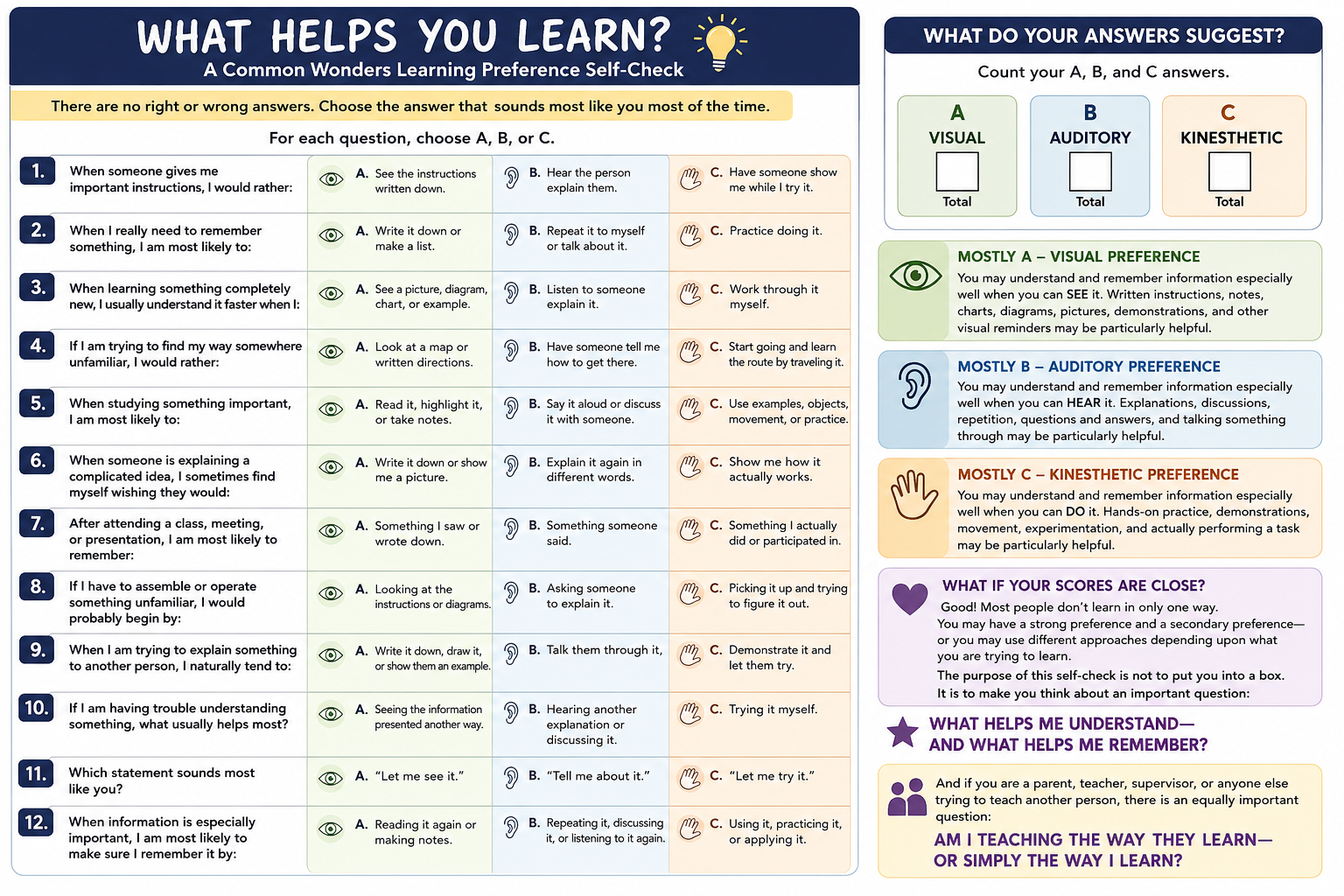
Three common learning preferences are Visual, Auditory, and Kinesthetic. In simple terms:
Visual – “Let me see it.” Pictures, diagrams, charts, written instructions, demonstrations, lists, notes, and other visual reminders may help make information clear and accessible.
Auditory – “Let me hear it.” Spoken explanations, discussions, questions and answers, repetition, and talking through a problem can help a person process information.
Kinesthetic – “Let me do it.” Hands-on activities, practice, movement, and demonstrations that a person can participate in, along with learning through experience, may help information become meaningful.
These descriptions are useful guides, not rigid boxes. Most people use a combination of approaches, and what works best can vary by the task.
We Don’t Always Have Just One
I am a good example.
I am very much a visual learner. I need to read information, see it in front of me, and often write it down before I feel I truly have it.
But auditory learning is important to me, too. I can listen to someone explain something and understand what is being said. However, if the information is important and I need

to remember it, I will always take notes. Later, I will reread and study those notes.
In other words, I may hear the information, but I deepen my understanding by making it visual.
That is why identifying learning preferences should never be about placing someone into a single category. A person might have a primary preference and a strong secondary one. Different approaches can also work together.
A useful question is not simply, “What kind of learner are you?” A better question may be: “What helps you understand, and what helps you remember?”
Don’t Teach Only the Way You Learn
Here is where the subject becomes especially important for parents, teachers, supervisors, and anyone responsible for helping others learn.
We naturally tend to explain things in the way that makes the most sense to us.
If you understand best by hearing it explained, you may talk your way through instructions. If you are highly visual, you may automatically reach for a piece of paper to draw a diagram. If you learn by doing, you may say, “Here, let me show you.”
The problem arises when we assume that because a method works for us, it should work equally well for everyone else. It may not.
A child who struggles with a lengthy verbal explanation might understand the same information when shown a picture or a written list. Another child may stare at a page of instructions in confusion but understand them better when someone talks through the steps. Someone else may need to try the task before the idea really takes hold.
Adults can experience the same thing.

Why This Matters for Parents and Teachers
Understanding how a child best receives and processes information can change both teaching and communication. A child may understand a lesson while it is being explained but need to see it written down to retain it. Another may read the material but understand it better after discussing it aloud. Still another may need to work with the information physically before the idea really takes hold.
Recognizing these differences can also change how we interpret behavior. Before deciding that a child isn’t listening, an employee doesn’t care, or an adult “just doesn’t get it,” it may be worth trying a different way to present the information.
A Learning Styles Inventory questionnaire can be one tool to start that conversation. Observation is another. Ask questions. Try different approaches. Notice what helps the person understand, remember, and apply the information.
 An Important Caution
Learning preferences should not be treated as fixed scientific categories or as proof that a person can learn only through one method. Research has not established that teaching exclusively to a person’s identified “learning style” automatically improves learning. The practical value lies in recognizing that people differ, using multiple ways to communicate, and paying attention to what helps an individual understand and retain information.
The Message to Remember
Don’t teach only the way you learn.
Sometimes, “I don’t understand” does not mean “I can’t learn this.” It may simply mean: “I need you to show me another way.”