 Do you remember trying to say “Peter Piper picked a peck of pickled peppers” three times without making a mistake?
Or perhaps you remember “She sells seashells by the seashore”.
For many of us, tongue twisters were part of growing up. We challenged our friends, laughed at our mistakes, and tried again—usually speaking faster each time. The goal was simple: Say the words three times without getting your tongue tangled!
But have you ever wondered why something that seems so easy on paper can be so hard to say out loud?
What Is a Tongue Twister?
A tongue twister is a phrase or sentence intentionally difficult to pronounce, especially when repeated quickly.
Most tongue twisters use words with similar sounds, repeated consonants, or syllable combinations that make our mouths work a little harder.
Although we call them tongue twisters, our tongues aren’t working alone. Our lips, teeth, jaws, vocal cords, and brains must all cooperate. Sometimes they don’t cooperate quickly enough!
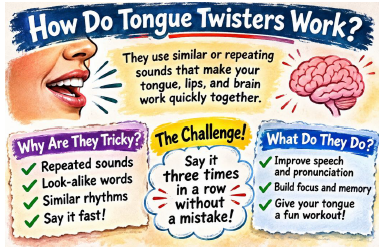 Why Do We Get Tongue-Tied?
Most of us speak without thinking. Our brains organize the sounds we want to make and coordinate the muscles needed to produce them. But tongue twisters pose a challenge.
When similar sounds appear close together, our brains must quickly coordinate the movements needed to pronounce each word correctly. The faster we speak, the more opportunities we have for mistakes.
For example, try saying: “Red leather, yellow leather.” Now say it three times quickly.
Did you stumble?
If you did, it’s because your tongue and other speech muscles must shift rapidly while your brain keeps track of the next sound. Even people who speak clearly and confidently can stumble over a good tongue twister.
Tongue Twisters Have Been Around for Generations.
Long before television, smartphones, and video games, children entertained themselves with word games, riddles, rhymes, and tongue twisters.
One of the best-known examples, “Peter Piper,” was printed in the early 1800s. Another familiar favorite, “She sells seashells by the seashore,” became popular in the 19th century.
These playful phrases have survived for generations because they are easy to remember, difficult to master, and often hilarious when someone gets them wrong.
Tongue twisters aren’t just for children. Actors, singers, public speakers, and others sometimes use them as vocal warm-ups to practice clear pronunciation.
Are You Ready for the Three-Times Challenge?
Here comes the fun part! Read each tongue twister aloud, then try repeating it three times without stopping or making a mistake.
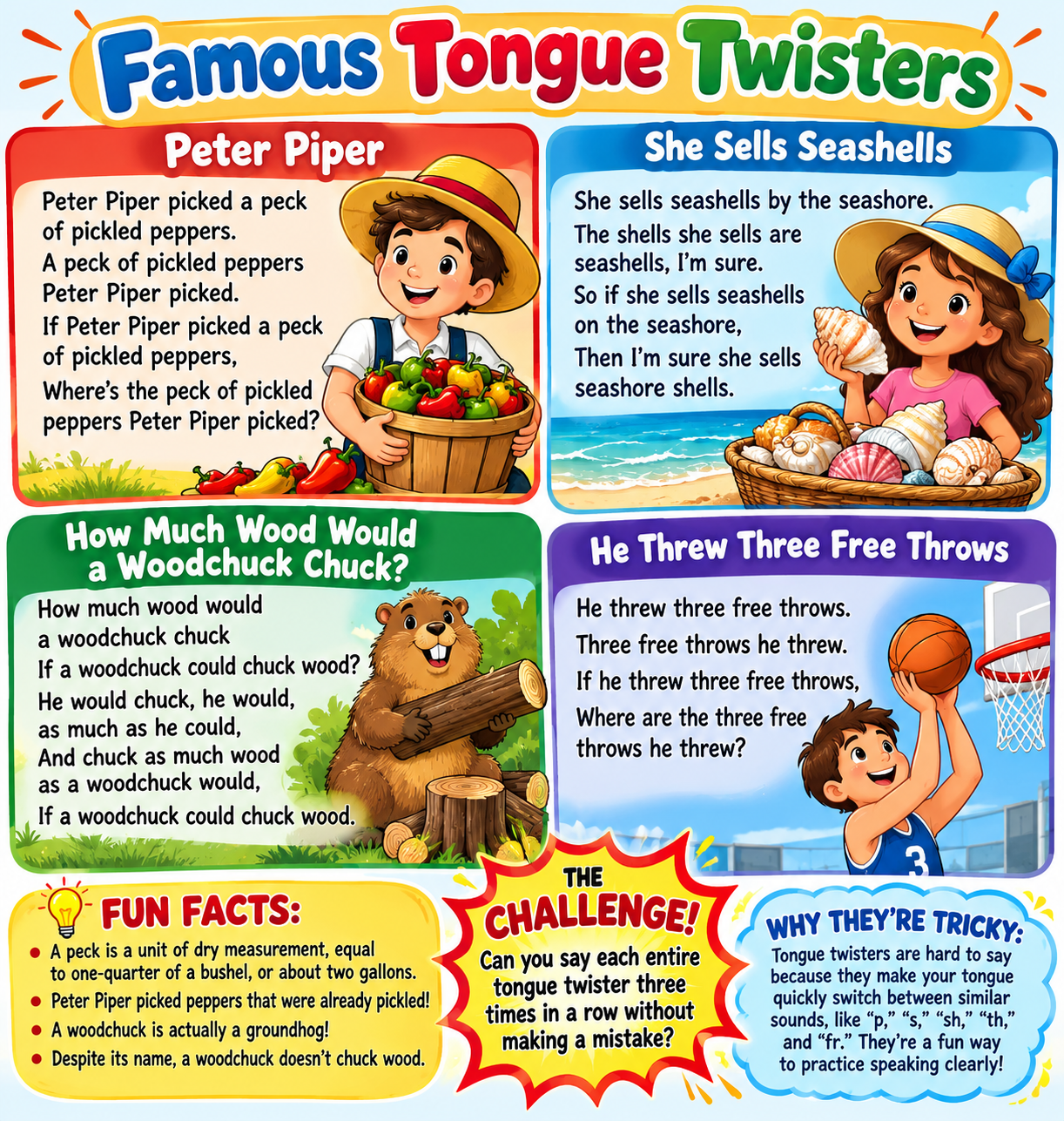
How did you do?
If you made it through these four without stumbling, congratulations! You may have a talent for tongue-twisting.
If you didn’t, you’re in good company! Remember, the fun isn’t in getting every word right. It’s in trying, laughing, and giving your tongue another chance!
More Than Just Silly Words.
Tongue twisters offer more than a few laughs.
They encourage us to pay attention to how we pronounce words, practice coordinating speech movements, and concentrate on what we’re saying. They also remind us of something we sometimes forget as adults: Learning and practicing a skill can be enjoyable.
The best part is that tongue twisters don’t require any special equipment, money, or technology. All you need is your voice, a few willing participants, and a sense of humor.
One Last Challenge!
Before you leave, try this one. It is considered one of the hardest tongue twisters in the English language.
“The sixth sick sheik’s sixth sheep’s sick.” Say it three times—quickly!
 Now imagine trying it with a room full of friends or family. Somewhere between the first and third attempts, someone will probably burst out laughing. And isn’t that part of the fun?
Sometimes the simplest things from childhood can still bring us the biggest smiles.