

October is National Bullying Prevention Month. Much of the attention focuses on children, but bullying does not necessarily end when childhood ends. In our previous article, we explored childhood bullying and its harm. We ended with a question: What happens when bullies grow up?
Some change their behavior as they mature, while others continue to bully, though their methods may become less obvious.
The playground may be behind us, but bullying can persist into adulthood. Sometimes, the adult bully is someone we least expect.
 What Is Adult Bullying?
Adult bullying typically involves repeated behavior that intimidates, humiliates, undermines, or controls another person. It can occur in workplaces, community organizations, social groups, neighborhoods, families, and even among longtime friends.
Not every disagreement is bullying. Adults argue, get frustrated, and sometimes say things they regret. A demanding supervisor or someone with a difficult personality is not necessarily a bully.
The difference often involves a repeated pattern of mistreatment and an imbalance of power. That power does not always come from a job title. It may stem from money, popularity, social connections, influence, or the ability to turn others against someone.
What Does Adult Bullying Look Like?
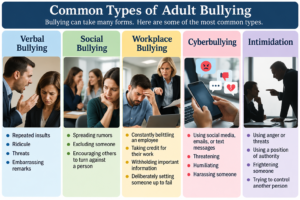
Adult bullying is not always loud or aggressive. Sometimes it is subtle enough that others barely notice. It can take the form of verbal attacks, social exclusion, workplace mistreatment, cyberbullying, or intimidation. This behavior may happen publicly. Other times, it occurs privately, allowing the bully to deny what happened.
Why Do Some Adults Bully?
There is no single explanation.
Some people bully to gain power or control. Others may feel threatened by someone’s success, confidence, abilities, or popularity. Jealousy, insecurity, prejudice, frustration, and learned behavior can also contribute to bullying.
An adult who grew up around intimidation or humiliation may have learned that mistreating others is an acceptable way to handle conflict. However, understanding the possible reasons for bullying does not excuse the behavior.
A difficult childhood or feelings of insecurity does not automatically make someone a bully.
Do Childhood Bullies Become Adult Bullies?
Some do, but many do not.
Research suggests that children who repeatedly bully others may be at higher risk of later aggressive or antisocial behavior. However, childhood behavior does not determine a person’s future. People mature, develop empathy, and learn better ways to handle disagreements.
Likewise, someone who never bullied another child may develop bullying behavior in adulthood.
Bullying is a behavior that can change, not a permanent label.

When the Bully Has Authority?
Adult bullying can be especially troubling when the bully holds a position of authority.
Imagine an employee whose supervisor repeatedly humiliates them in front of coworkers, or a volunteer who is constantly belittled by a community organization’s leader.
Speaking up may feel risky. The person being bullied may fear losing a job, friendships, opportunities, or standing in the community. Sometimes others witness the bullying but stay silent because they fear becoming the next target.
These are reasons adult bullying can continue for months or even years without being challenged. No single solution exists, but several steps may help.
Recognize the pattern: Repeated humiliation, intimidation, and deliberate mistreatment shouldn’t be dismissed as merely someone’s personality.
Keep a record: Document what happened, when, and who witnessed it.
Set boundaries: When it is safe, calmly explain which behaviors are not allowed.
Seek support: Talk to someone you trust or to the appropriate authority.
Avoid retaliation: Responding in kind may make the situation worse.
Sometimes limiting contact or leaving an unhealthy situation is the best way to protect one’s well-being. Threats, unlawful harassment, or discrimination may also require formal reporting.
 What About the Bystanders?
Bullying rarely affects only two people. Coworkers, neighbors, friends, and members of organizations may witness it. Some laugh along, while others stay silent, even when they know the behavior is wrong.
But bystanders can make a difference. Refusing to participate in gossip, supporting someone who is mistreated, or speaking up safely can help prevent bullying.
Sometimes a simple statement like “That wasn’t necessary” sends an important message.
Growing Older Should Mean Growing Wiser
We teach children to be kind, respect differences, and treat others as they would like to be treated. Those lessons should not expire when we become adults.
 Adult bullying can harm confidence, relationships, careers, and emotional well-being. Recognizing the behavior is an important first step toward stopping it.
Perhaps the most important lesson of National Bullying Prevention Month is that preventing bullying is not only about teaching children how to behave but also about adults setting an example.
That leaves us with one final question: If we expect children to stop bullying one another, shouldn’t we expect the same from ourselves?