A Name Is Not Always Just a Name
Before we begin, it’s worth noting something about the names of animal groups. They are not always universal.
The terms used to describe animal groups have evolved over centuries and can reflect language, history, culture, region, and tradition. A term common in one country may be unfamiliar—or rarely used—in another. Some names are widely recognized scientific or everyday terms, while others originated in hunting traditions, literature, folklore, or playful language.
That is why an animal may have more than one collective name. A group of animals might commonly be called a herd, colony, pack, or flock, while also having a more colorful traditional name. Those colorful names are where the fun begins.
Most of us learned a few animal group names as children. Fish gather in a school. Dogs travel in a pack. Geese form a gaggle. Simple enough.
But then the English Language Gets Wonderfully Strange
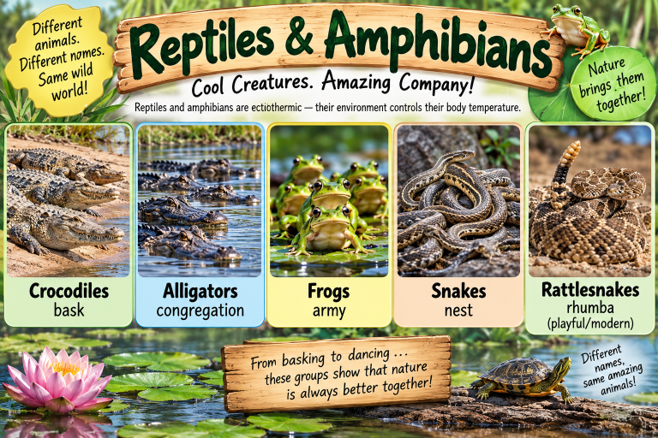
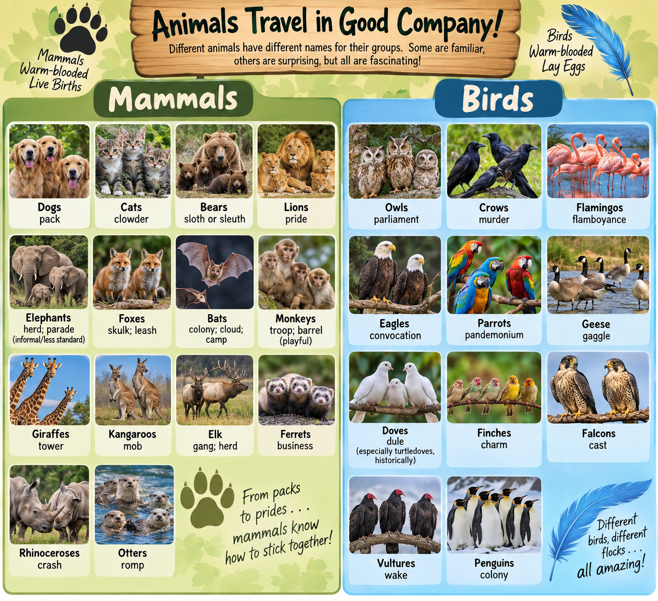
A group of giraffes can be called a tower. Flamingos form a flamboyance. Crows gather in a murder. Frogs can be an army, and sharks a shiver.
Who Came Up With These Names – and Why?
That innocent question opens the door to a centuries-old blend of hunting tradition, observation, humor, imagination, and wordplay.
A Language With a Long Memory
Many unusual animal collective nouns are connected with the medieval tradition known as terms of venery, which are specialized words associated with hunting and the animals hunted.
One of the best-known historical sources is The Book of Saint Albans, printed in England in 1486. Its famous list preserved scores of collective expressions. Some were practical hunting terms; others were playful, descriptive, or intended to showcase a speaker’s knowledge and wit.
The book did not invent every animal group name, and many colorful expressions heard today appeared later on.
That is an important distinction: these names are not a scientific system established by zoologists. Some are ordinary everyday words, some are traditional terms, and some survive mainly because they are irresistible to say.
Sometimes the Name Paints the Picture
Some collective nouns seem almost inevitable once you hear them: a cloud of bats, or a crash of rhinoceroses. The word itself creates an image.
Sometimes It Sounds a Little Ominous
Then there are names that make the animals sound far more dramatic: a murder of crows, a wake of vultures, a smack of jellyfish, and a plague of locusts. The term ‘murder of crows’ is especially old; it dates to the late 1400s.
And Sometimes You Have to Wonder Who Thought of It
A parliament of owls. A business of ferrets. A pandemonium of parrots. A charm of finches. A romp of otters. These are the names that turn a simple vocabulary question into a Common Wonders question.
The Best Part?
You do not have to memorize any of them. The pleasure is in discovering how inventive language can be. A group of animals may simply be a group, but somewhere along the way, people looked at how creatures gathered, behaved, moved, sounded, or appeared and decided that an ordinary word just would not do.
Now, Let’s Have Some Fun
You have seen how unusual—and sometimes wonderfully unexpected—animal group names can be. Now it is your turn. Before looking at each picture, try to guess the answer.
What is a group of ferrets called?
A committee, A company, A business
What is a group of jellyfish called?
A bloom, A smack, A swarm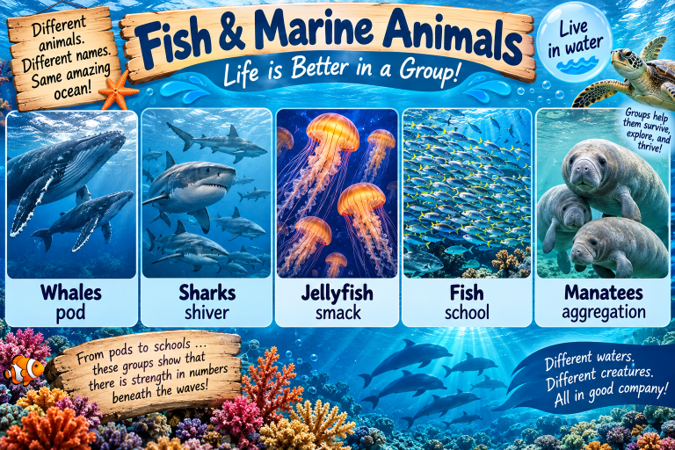
Which sounds more like a group of butterflies?
A flutter, A rainbow, A kaleidoscope.
It may be one of the prettiest collective names of all. 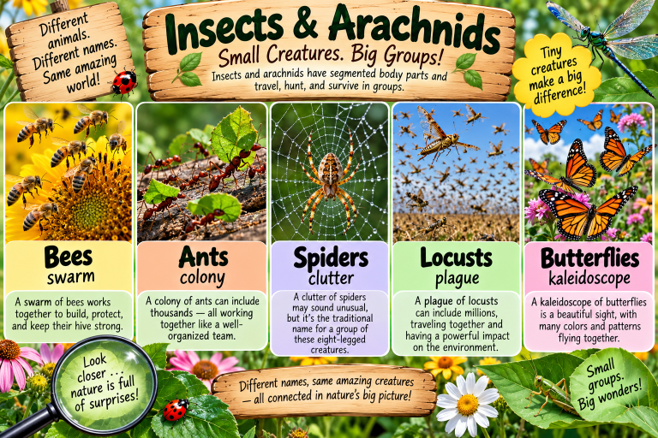
What is a group of alligators called?
A congregation, A gathering, A colony