
 Mention the word Fiat, and some people will immediately think of the small Italian car.
But there is another fiat that affects virtually every American every day. It is in our wallets, bank accounts, paychecks, mortgages, savings, and even the numbers we see when we check our bank balances online.
The United States dollar is fiat currency. But what does that mean?
Most of us grew up believing that a dollar was worth a dollar. We handed over a dollar bill and received something in return. We deposited money in a bank and expected it to be there when we needed it. We didn’t stop to ask a rather peculiar question. Why does this piece of paper—or even a number on a computer screen today—have value?
Before we answer that question, however, perhaps we should give that little Italian automobile its moment in the spotlight.
But First, What About the Car?
Fiat automobiles date back to 1899, when the company was founded in Turin, Italy. Its first automobile, the Fiat 3½ HP, was produced that same year. And the name itself has an interesting story.
FIAT originally came from Fabbrica Italiana Automobili Torino—essentially, the Italian Automobile Factory of Turin. But the word fiat existed long before anyone put it on an automobile.
It comes from Latin and carries the sense of “let it be done” or “let it be so.” In ordinary use, a fiat is something put into effect by authority—a decree, order, or proclamation. In other words, something does not become so because it naturally occurred or because everyone independently agreed to it; it becomes so because an authority has declared or established it.
 Before Money Was Money
Long before there were dollar bills, checking accounts, credit cards, or Federal Reserve banks, people still needed a way to exchange things of value.
At first, exchange could be quite literal. A person with grain might trade some of it for an animal, a tool, or another needed item. But direct exchange had an obvious problem. What happens if you have something I want, but I don’t have anything you want?
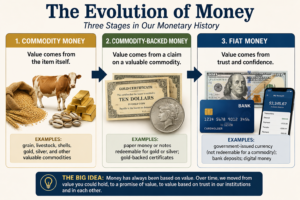
Societies gradually began using certain widely valued goods as a common means of exchange. Depending on the place and period, commodities such as salt, livestock, shells, metals, and eventually gold and silver served this purpose. This was commodity money.
Commodity money had something our modern paper dollar does not: the item used as money had value apart from its use as money. A gold coin, for example, contained gold. Even if everyone suddenly stopped calling it “money,” the gold itself would still have value.
From Commodity Money to Commodity-Backed Money
Carrying and exchanging valuable commodities was not always convenient. Over time, another idea emerged: instead of carrying the commodity itself, people could carry a piece of paper representing a claim to it. The paper wasn’t valuable in itself. It was valuable because the holder could exchange it for a specified amount of something valuable—most commonly gold or silver. This was commodity-backed, or representative, money.
For much of American history, gold and silver played important roles in the monetary system. By the nineteenth and early twentieth centuries, the United States operated under various forms of a gold-based monetary system. Under a true gold standard, paper currency wasn’t merely a government promise that “this is money.” Instead, it could be tied to—and, under the applicable rules, exchanged for—a specific quantity of gold. That distinction is important.
If you held a gold-backed note, the promise was backed by something tangible. Today, you cannot take a $100 bill to the United States Treasury and demand $100 in gold in exchange. So, what happened?

How Did a Dollar Become a Fiat Dollar?
The transition did not happen overnight.
During the Great Depression, the United States dramatically changed the relationship between its currency and gold. In 1933, the Roosevelt administration suspended domestic gold convertibility, and the Gold Reserve Act of 1934 further changed the nation’s monetary system.
Gold did not immediately disappear from the international monetary system, however.
After World War II, the Bretton Woods system established a new arrangement. Other participating currencies were generally tied to the U.S. dollar, while the dollar itself remained convertible into gold for foreign monetary authorities at a fixed price of $35 an ounce.
Then, in August 1971, President Richard Nixon ended the convertibility of U.S. dollars into gold for foreign monetary authorities. The dollar’s final formal link to gold was severed. The United States had entered the modern era of fiat currency.
So, What Is Fiat Money?
The word fiat comes from Latin and essentially refers to something established by authority or decree. In monetary terms, fiat money is currency that is not redeemable for a fixed amount of a commodity such as gold or silver. A $20 bill is worth $20 not because there is $20 worth of gold sitting somewhere with your name on it, nor is it because the paper and ink are worth $20.
It works as money because the United States has established its currency within a legal and monetary system—and because millions of people, businesses, banks, governments, and institutions accept and trust that currency in exchange for real goods, services, labor, debts, and taxes. That last point is extremely important. It is tempting to say that fiat money has value simply “because the government says so.”
But that doesn’t tell the whole story. Government authority matters. Legal tender laws matter. The ability to pay taxes and debts in dollars matters. But so do confidence and acceptance.
A monetary system ultimately requires people to believe that the money they accept today will still be accepted by others tomorrow.
 Then Who Is in Charge of Our Money?
This is where the story becomes even more interesting.
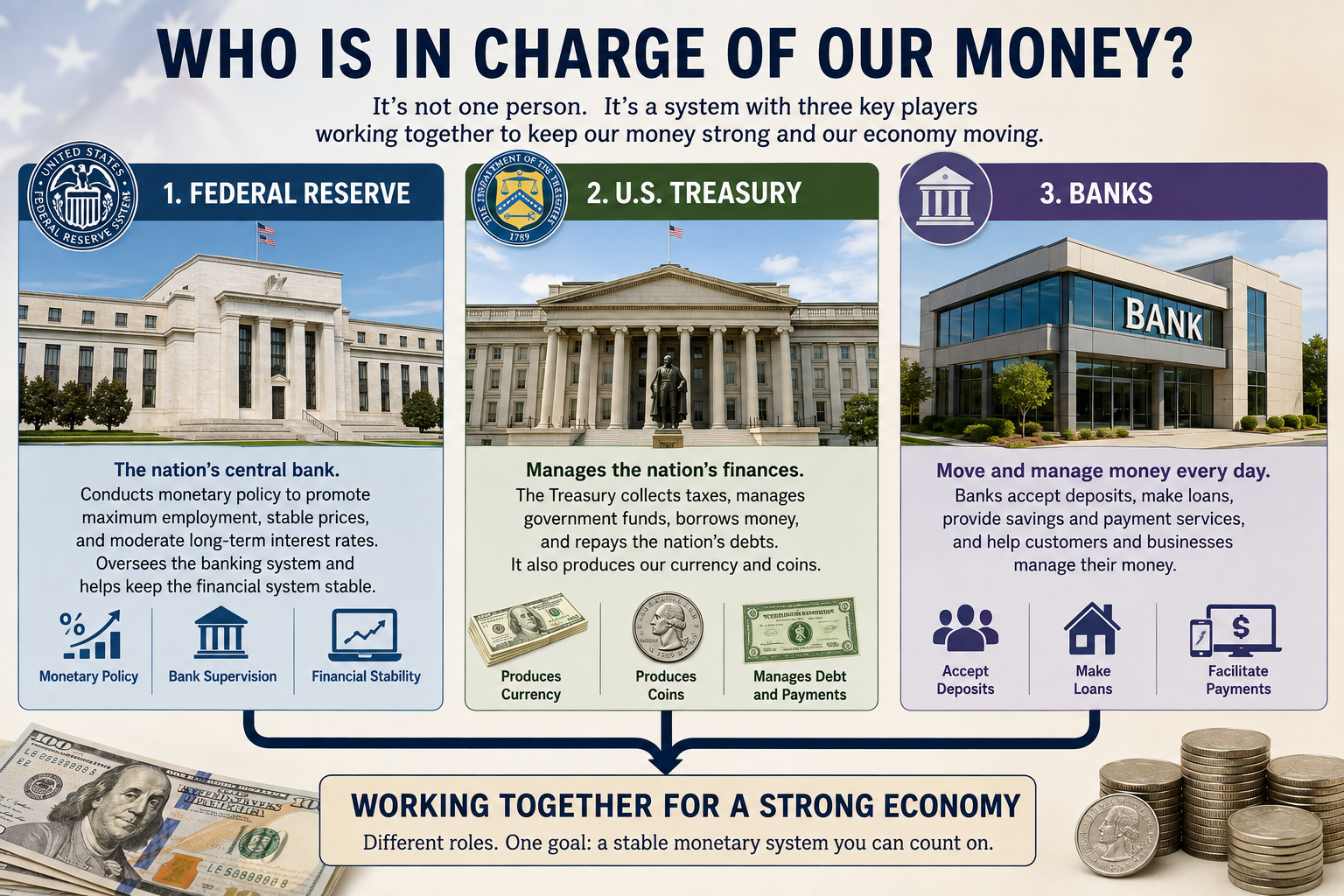
There isn’t one person sitting somewhere in Washington deciding how many dollars America should have. Different responsibilities are divided among several institutions.
In 1913, the United States Congress created the Federal Reserve System and established the laws governing the nation’s monetary framework. As the nation’s central bank, the Federal Reserve conducts monetary policy and plays a central role in the banking and payments system.
The U.S. Treasury manages federal finances and, through the Bureau of Engraving and Printing and the U.S. Mint, produces currency and coins.
Commercial banks are important to the money supply. Much of what Americans call “money” today isn’t paper currency at all. It exists as bank deposits and moves electronically from one account to another.
When someone asks, “Why doesn’t the government just print more money?” the answer is considerably more complicated than the question suggests.
If Our Money Isn’t Backed by Gold, What Is Backing It?
A vault with a corresponding pile of gold does not back our money today.
The modern dollar rests on something less tangible yet immensely important: the strength and productive capacity of the U.S. economy, the institutions and laws that support the monetary system, the government’s ability to levy taxes and meet its obligations, monetary policy, and—perhaps most importantly—the ongoing confidence of the people and institutions that use dollars.
That confidence matters because fiat money contains an interesting contradiction. A dollar has value because we accept it, and we accept it because we believe it has value. That arrangement can work extraordinarily well.
But history has also shown that confidence in money cannot be taken for granted.
And that may be the real lesson hidden inside that little word fiat.