
In meeting rooms across towns and counties, civic organizations gather with a shared purpose—at least, that’s how they started.
 There are agendas to review, projects to discuss, and names on the membership rolls. Some arrive early, setting up chairs or organizing materials. Others slip in quietly as the meeting begins. In nearly every group, a familiar pattern emerges: a small number of people do most of the work, while many others simply hold the title of member.
It raises a quiet question—one seldom asked aloud. What were these organizations originally intended to be?
Civic organizations were not originally centered on belonging. They were built around contribution. They formed when communities identified a need—something that required time, effort, and shared responsibility. Whether the goal was to support neighbors, improve local conditions, or respond to challenges, the core idea was simple: people coming together to do what mattered.
Across communities, these organizations often form around very real needs.
 Some focus on supporting veterans—men and women who carry the weight of service long after their time in uniform ends.
- Others focus on children, working to provide stability, opportunity, and protection during the most formative years.
- Some serve senior citizens by providing connection and care where loneliness might otherwise take hold.
- Many people advocate for animals, recognizing the responsibility humans have to those who depend on them.
- And some respond to one of the most visible and immediate needs of all—those without stable housing, for whom daily life can become a matter of survival rather than stability.
The missions may vary, but the core idea remains the same: someone, somewhere, needs help—and these organizations exist to help meet that need.
Membership was never intended to be the outcome. It was meant to be the starting point.
There is also a more difficult truth—one rarely spoken aloud.
Civic organizations are not résumé builders. They are not placeholders for social connection or for passive memberships. They are founded on participation. They rely on effort. They exist because people are willing to serve.
When someone joins without the intention to participate or to carry even a small share of the workload, they are not just staying on the sidelines. They are shifting the burden onto others.
There is also a line that should not be crossed: taking credit without contributing. A title alone is not service, and participation cannot be claimed where it does not exist.
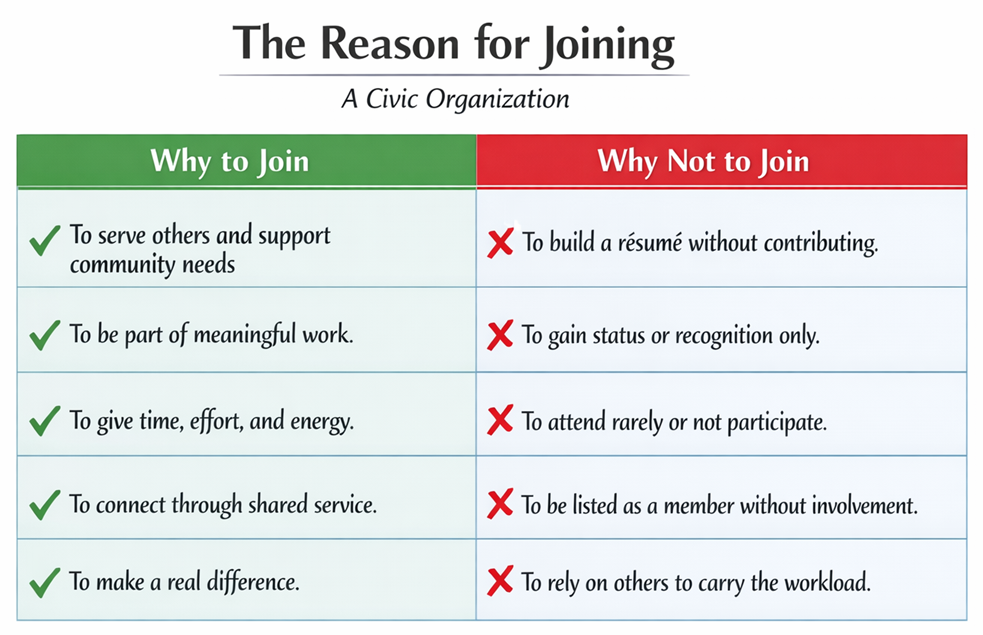 Over time, that imbalance becomes clear. A few take on the mission, while many simply carry the name.
And something important starts to weaken.
This isn’t about perfection or being constantly available. Life is busy, and responsibilities are real. Yet civic organizations were never meant to rely on a few people while many remain disengaged.
At the heart of every genuine civic organization is a simple idea: the work is more important than recognition.
It asks something of its members—not everything, but something. Not constant presence, but consistent intention. A willingness to show up when it matters. A willingness to contribute however one can.
If the intention to participate isn’t there, then joining might not be the best choice.
Not everyone is meant to join a civic organization, and that’s perfectly okay.
Communities need many kinds of involvement—whether people serve on their own or through organized civic groups.
But for those who choose to join, there is an unspoken expectation: to actively contribute, not merely be associated.
Because in the end, civic organizations are not defined by how many names appear on a membership list.
They are characterized by the number of people willing to serve.
By: Sandra Hartley.