
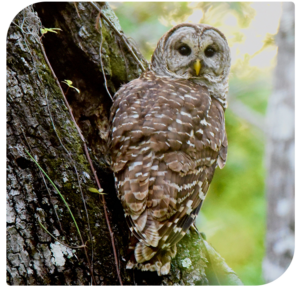
 In the backyard of a friend who lives in Clay County, a Barred Owl makes regular visits. I came to call the owl Sagacious.
Sagacious usually arrives at dusk—sometimes silent as a shadow, other times announcing his presence with a deep, rhythmic hoot. To human ears, that call sounds remarkably like words: “Who cooks for you? Who cooks for you-all?”
The owl isn’t asking a question. The phrase is simply how English speakers interpret the Barred Owl’s call’s cadence. It’s one of the few bird sounds that mimic human speech so closely that people remember it for life.
To some listeners, it fades into the background—just another nighttime sound. But for those who pause to listen, that familiar call becomes an invitation to notice something wild and enduring.
Sagacious earned his name for a reason. Sagacious means wise and perceptive—qualities long associated with owls. Across cultures and centuries, owls have symbolized knowledge, mystery, and insight.
In ancient Greece, the Little Owl was sacred to Athena, the goddess of wisdom, and appeared on Athenian coins alongside her composed profile. Its wide eyes and silent flight became symbols of clarity and thoughtful observation. In English folklore, this reputation gave rise to the phrase “wise as an owl,” later reinforced by the well-known nursery rhyme:
“A wise old owl lived in an oak,
The more he saw, the less he spoke;
The less he spoke, the more he heard;
Why can’t we all be like that wise old bird?”
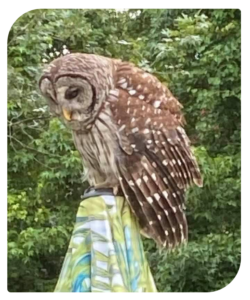 That quiet attentiveness—watching more than acting—still shapes how people perceive owls today. Sagacious, true to his name, seems to embody the same calm awareness during his nightly visits.
The Barred Owl is not rare in Florida, yet its presence remains noteworthy. While some bird species struggle as development expands, Barred Owls have adapted well to living near people. They favor mixed woodlands and swampy areas, but they also thrive in large trees behind homes and along neighborhood creeks. As long as old trees provide nesting cavities and small prey remains plentiful, Barred Owls can stay in one place year-round.
That adaptability makes Sagacious part of the Southeast’s quieter success stories. While other species retreat as forests shrink, Barred Owls continue to raise families and call through the night—even as subdivisions encroach on former woodland.
Many residents don’t realize an owl is nearby until it appears in full view. Sagacious’s still posture and round, dark eyes leave a lasting impression. He doesn’t flutter or dart like smaller birds. Instead, he watches—motionless, patient. His gray-and-brown-streaked feathers blend so perfectly with tree bark that he can almost vanish into the background.
Those who notice Sagacious often describe him the same way: beautiful yet firm. The phrase fits. There’s a quiet confidence in his presence—neither aggressive nor timid. He moves only when there’s a reason to.
Like others of his kind, Sagacious hunts at night. His diet consists mainly of rodents, frogs, and small birds. Rather than relying on sight alone, Barred Owls use broad facial disks to funnel sound to their ears. In the stillness of a Florida evening, the faint rustle of leaves can be enough. The strike is swift and nearly silent, then a return to the perch.
Their family life is equally compelling. Mated pairs often stay together for years, returning to the same nesting site each season. During nesting, Barred Owls are fiercely protective. Observers who approach too closely sometimes learn that the “wise old owl” can respond forcefully when its young are threatened.
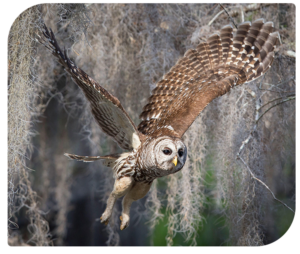 Here in Clay County, the landscape keeps changing, yet Sagacious’ call still echoes through the night woods and across quiet backyards. For those who listen closely, it’s a reminder that wildness persists—not only in distant preserves but right alongside everyday life.
The next time that familiar hooting rings out— “Who cooks for you-all?”—it may not just be a sound drifting through the trees. It may be Sagacious, the wise old owl, marking his place in a world where nature and neighborhoods still overlap.
Author’s Note:
This story was inspired by repeated visits from a Barred Owl in a Clay County yard. Sagacious reminded me how closely wisdom and adaptability intertwine in nature—and how much we can learn by paying attention to what watches quietly from the dark.
By Sandra Hartley
February 2026