
 Why are spiders so feared? Perhaps it’s a learned childhood behavior, with adults warning kids to steer clear of spiders because they bite, even when no one they know has been bitten. Movies like Arachnophobia and Eight-Legged Freaks reinforce these fears by portraying spiders as creepy and dangerous. Add Halloween’s spider-filled decorations, and the fear becomes deeply ingrained.
Is it their alien-like features, eight legs, multiple eyes, and nocturnal habits that make spiders so unsettling?
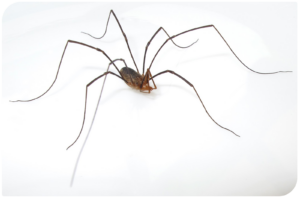
Yet one creature often mistaken for a spider has an unjustly bad reputation: the Harvestman, better known as grandaddy or daddy longlegs. Dubbed the “most venomous spider,” this gentle arachnid’s reputation couldn’t be further from the truth.
The Harvestman belongs to the Opiliones group, making it closer to mites and scorpions than to spiders. It lacks venom, and its tiny fangs cannot pierce human skin. Unlike spiders, it doesn’t spin webs and has only two eyes instead of eight. Its vision is generally poor, and the second pair of legs, usually the longest, function as “feelers” as it walks around, like a blind person tapping a cane. It poses no threat to humans.
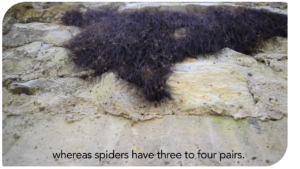
Despite its creepy-crawling look, this little creature deserves admiration, not fear. They hang around shady building sides and crawl spaces in summer. In fall, they congregate in large numbers – a sight that may be unsettling but is harmless.
Their long, slender legs, sometimes six times the length of their tiny bodies, are nature’s engineering marvel. These legs bristle with sensory hairs that detect air currents, vibrations, scents, and distant dangers. Harvestmen employ clever defenses to escape predators: they can detach a leg, emit a pungent odor (like a miniature skunk), or even play dead like an opossum.
 Harvestmen are nature’s unsung recyclers, clearing away decaying organic matter without hunting live prey. They’re detritivores, scavenging dead insects, fungi, decomposing plant material, and even feces. Their role is vital in returning nutrients to ecosystems, making them far more friends than foes.
Why does the myth of their venom persist? Perhaps their spider-like appearance and delicate legs are misleading. Whatever the reason, it’s time to unmask the Harvestman and appreciate its harmless, beneficial nature.
Although these gentle recyclers are harmless, not all arachnids share the same reputation.
From gentle recyclers to genuinely venomous arachnids, the world of spiders and their relatives is full of surprises. The next time you spot a Harvestman, admire its grace and vital role in the ecosystem. It’s not a horror-movie monster but a marvel of nature.
True Arachnid Villains: Black Widow and Brown Recluse
Although the Harvestman poses no danger, Florida is home to two spiders that merit respect: the black widow and the brown recluse.
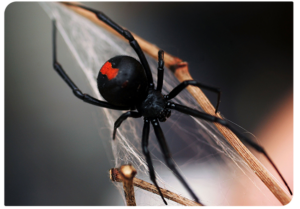
Black Widow Spidere Harvestman poses no danger, Florida is home to two spiders that merit respect: the black widow and the brown recluse.
Black Widow: This infamous spider avoids confrontation and bites only in self-defense. Females, distinguishable by their black bodies and the iconic red hourglass marking, have neurotoxic venom that causes pain, muscle cramps, and difficulty breathing. Males, which can be black or brown with red or brown dots, do not bite. Black widows hide in places like woodpiles, sheds, and garages—so be cautious in their territory.
Brown Recluse: Found in dark corners, closets, shoes, and beds, this venomous spider is unassuming yet dangerous. Its cytotoxic venom can cause severe tissue damage and necrosis, leading to slow-healing wounds, fever, and nausea. A brown recluse bite is even more dangerous than a black widow’s bite.
A Note of Perspective
While the Harvestman is harmless, Florida has a few spiders that warrant caution—most notably the black widow and brown recluse. These spiders are not aggressive, and bites are rare, but awareness matters, especially in sheds, garages, and storage areas.
Knowing the difference helps replace fear with understanding—one of the simplest ways we learn to live more comfortably alongside the small creatures that share our spaces.
By: Sandra Hartley
February 2026