
Growing up in the South, I have always called an opossum a possum. I thought it was a nickname, like Sandy for Sandra. But my assumption was wrong.
 Opossums have existed for millions of years. They are a type of mammal native to the Americas. The species’ long existence is due to its ability to quickly adjust to its environment. If their habitat changes, they adapt to a new one. If their food source changes, they change their diet.
This is the animal we see in our area. It is found in Florida’s urban, suburban, and rural areas. It has pale to dark gray fur, a long, hairless tail, and opposable thumbs that can grip like human hands.
The opossum gets a bum rap, often labeled a vicious animal. If you have ever encountered one, you know it has a wicked hiss and many teeth to flash when scared. But the truth is, they are sweet-tempered and seldom bite. The “vicious animal” tactic is meant to scare away predators.
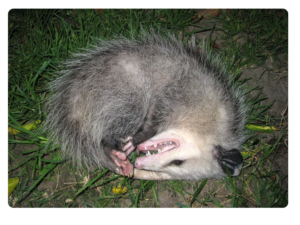
If it can’t scare the threat away, this creature has another defense—“playing possum.” However, the possum’s faking death isn’t entirely an act.
The opossum has an involuntary, stress-induced nervous collapse that is very convincing. It falls on its side, opens its mouth, appears limp, drools, stares into space, and emits a foul odor from its anal glands. It doesn’t respond to sound or prodding. Because most predators don’t eat decaying meat, they will often move on.
Opossums repeatedly fooled Sunny, my 75-pound dog. Once, he brought a “dead” opossum through the dog door and left it in the living room. Because this catatonia-like state may last minutes or hours, I was able to take it back outside before it awakened. Eventually, it woke up and left as if nothing had happened. Sunny was totally confused.
The opossum is the ideal visitor to your yard. It’s quiet and doesn’t pick fights, leave foul odors, dig, or claw. Instead, it shuffles in, eats a rodent, scarfs down insects and snails, munches on fallen fruit, and then cleans up any leftovers in the dog food bowl. Opossums often kill cockroaches and rats they find in their territory. Unfortunately, they’re unfairly blamed for damage caused by other animals.
Opossums are often stung by bees and scorpions yet can tolerate those poisons. They rarely contract Lyme disease, even though they are often bitten by ticks. They typically eat the ticks before the ticks can infect them. Opossums also have superpowers against snakes. They have partial or total immunity to the venom of rattlesnakes, cottonmouths, and other pit vipers. Scientists are recreating the peptide found in opossums to develop low-cost rattlesnake antivenom.
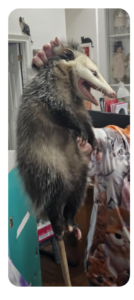 Listed are a few more “interesting opossum facts.
- Most Virginia opossums have short lives. In the wild, they live only a year or two; in captivity, they live three to four years.
- They cannot contract rabies because their body temperature is 94 to 97 degrees, which is too low for the virus to survive.
- They are obsessed with cleanliness and groom themselves as a cat does by licking its paws.
- They can almost smell anything, anywhere, because they have 1,188 olfactory (smell) genes, compared with humans’ 396.
- They have relatively poor eyesight, hearing, and a sense of taste.
- They have a keen sense of touch.
- They are good swimmers, both underwater and on the water’s surface.
- They can hang by their long tail for a short time.
If, for some reason, they cannot live in the wild.
- They can be litter box and leash trained.
- They love to be held and snuggled.
- They will greet their owners at the door.
- They will respond to their name when called.
Unexpected Revelation – The Aussie
As we’ve journeyed through the fascinating world of our marsupial friends, you might be thinking, “Wait a minute! Isn’t an opossum a possum, and a possum an opossum? After all, the terms are often used interchangeably, especially in everyday conversation.”
But here’s the delightful twist: calling an opossum a possum has always been a charming mix-up! Here’s the real reason.
Meet a common Australian native: the brushtail possum, a marsupial that lives both on the ground and in trees. These possums have large, pointed ears, a bushy tail adapted for grasping branches, and a thick, furry coat that varies in color—silver-gray, brown, black, red, or cream.
Here are some key points about the “real deal.”
- They feed primarily on plant material, especially eucalyptus leaves. They also eat shrubs and flowers and occasionally insects, baby birds, and bird eggs.
- They live in various habitats, including woodlands, busy areas, cultivated areas, rural gardens, and suburban and urban areas.
- They seek food in the tree canopy and on the ground, adapting to their surroundings.
- They are active at night, resting and sleeping during the day.
- Brushtail possums may hiss, growl, or show aggression. They defend themselves with their sharp claws and teeth.
- They DO NOT play dead like the opossum. Instead, they rely on agility and climbing skills to escape their threats.
- Their fur color and patterns provide camouflage in the environment.
- They live 10 to 12 years.
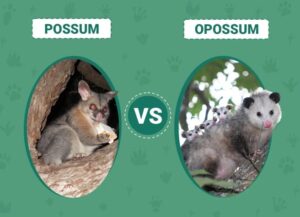 Opossums and Possums are Not the Same
While they share some similarities, they inhabit different continents, display distinct behaviors, and have unique defense mechanisms. Let’s embrace this newfound knowledge and appreciate our Virginia opossums and the “real deal” brushtail possums for their individual quirks and adaptations.
Next time you spot one of these remarkable creatures, you’ll be armed with the right name—whether it’s an opossum or a possum!
As the famous radio commentator Paul Harvey would say, “And now you know the rest of the story.”
By: Sandra Hartley
February 2026