
Recently, I found myself explaining to a young person the origin of the phrase “I’ll get your goat.” It sounded simple enough — just an expression we use when someone irritates us. But as I described its origin, I realized how many of our everyday sayings carry stories most of us have long forgotten.
We don’t usually think about the words we use. They slip out easily — “Get your ducks in a row,” “It’s raining cats and dogs,” and “The devil is beating his wife.” We assume everyone knows what we mean.
But why do these expressions exist in the first place?
Long before search engines and weather apps, people explained the world through images. They borrowed from what they saw — animals in fields, storms in the sky, sunlight breaking through rain. Language became a way to capture experience in a phrase vivid enough to remember and simple enough to pass along.
Expressions exist because humans are storytellers.
“I’ll Get Your Goat”
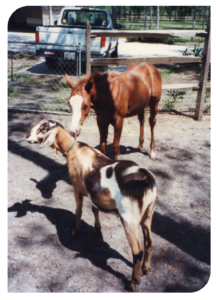 In the late 1800s and early 1900s, racehorses were often kept in stables alongside goats. Trainers believed goats had a calming effect on nervous horses. The animals bonded, and the goat’s steady presence helped settle the horse before a race.
Now imagine what would happen if someone removed the goat. The horse would grow restless, distracted, and agitated.
To “get someone’s goat” meant taking away what kept them steady — disturbing their calm and throwing them off balance.
The racetrack setting faded over time, but the meaning remained. Hidden inside that phrase is a small piece of agricultural and sporting history.
Years ago, at our home, we placed Ernie the goat with Blue-Eyed Jackie for much the same reason. What began as a practical arrangement became something more. The horse and the goat grew attached, often standing side by side as if they had always belonged together. Watching them made the old expression feel less like folklore and more like lived experience.
Sometimes language begins in barns.
“Get Your Ducks in a Row”
If goats belong to stables, then ducks belong to ponds and grassy shorelines.
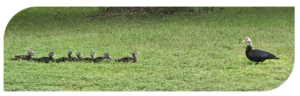 When we tell someone to “get your ducks in a row,” we mean to organize yourself — prepare, line things up, and make sure everything is ready before moving forward.
The image behind it is almost universally familiar. A mother duck steps forward, and one by one, her ducklings fall in behind her. They follow her across water and grass, even across sidewalks — forming a neat line wherever she leads.
Behind our home, I see this scene unfold regularly. A Muscovy mother swims across the pond, her ducklings trailing behind. Later, they waddle across the backyard in the same careful formation. No one instructs them. No one hands them a checklist. Yet they move with quiet order and shared direction.
The ducklings don’t line up randomly. They line up because they trust her destination. There is no lecture. No checklist. Just instinct and quiet direction.
That simple scene became shorthand for preparation and order. Animals, it seems, have helped us organize not only our farms but also our lives.
“Raining Cats and Dogs”
Some expressions lean toward exaggeration.
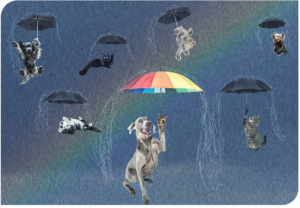 When the rain falls hard and fast, we don’t simply say it’s raining. We say it’s “raining cats and dogs.”
No one expects animals to fall from the sky. The phrase endures because it captures the feeling of a storm — loud, chaotic, overwhelming.
There are several theories about its origin. Some trace it to old European street conditions during heavy storms. Others connect it to older folklore or symbolic associations between animals and turbulent weather.
Whether literal or symbolic, the phrase reflects something deeply human: when nature feels dramatic, our language becomes dramatic, too.
A light drizzle doesn’t inspire flying animals. A pounding storm does.
“The Devil Is Beating His Wife”
In parts of the American South, a sun shower — rain falling while the sun is shining — has its own expression.
Someone might glance at the bright sky and the falling rain and say, “The devil is beating his wife.”
When sunlight shines through falling rain, a rainbow often appears. The same conditions that make the moment feel unusual — brightness and rainfall at once — also create that arc of color.
Like many old sayings, the phrase grew from folklore — an attempt to explain something visually strange and unexpected. A sun shower feels contradictory. Rain and sunshine at the same time. Before meteorologists described shifting air masses and passing storm cells, people reached for a story.
The phrase doesn’t attempt meteorology. It attempts meaning.
It reminds us that when something looks mysterious, humans respond with imagination.
When you line these expressions up — goats in barns, ducklings in rows, storms filled with animals, sunshine mixed with rain — a pattern begins to emerge.
Where the Words Come From
We don’t come up with language in laboratories.
We come up with it in fields, along pond banks, under unsettled skies, and on front porches. We borrow from what we see. We exaggerate what surprises us. We soften what confuses us. We turn repetition into metaphor and mystery into story.
The words we use every day have roots. Sometimes all it takes is a closer look to find them.
By: Sandra Hartley
March 2026