
See Have you ever tried navigating Fleming Island traffic while ordering a coffee on your phone and trying to remember what you needed at the grocery store? If so, you have experienced the chaos of modern multitasking.
In today’s fast-paced world, we embrace juggling multiple tasks, believing it boosts efficiency. However, research suggests this perception may be misguided. Focusing on one task at a time—monotasking—could be the key to greater productivity and improved mental well-being.
While multitasking might seem like a way to get more done, studies suggest it often has the opposite effect. Our brains are not designed to handle multiple complex tasks at once. Instead, we rapidly switch between tasks, incurring a “switch cost” as our brains struggle to readjust and refocus. This constant shifting can decrease productivity and cause errors, mental fatigue, stress, and exasperation.
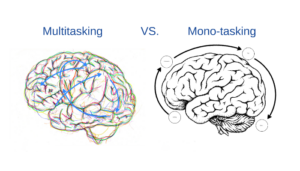 In contrast, monotasking – focusing on one task at a time – boosts productivity, improves work quality, sharpens focus and memory, deepens concentration, and reduces stress and frustration. We work smarter, not harder, by maximizing our brainpower and minimizing wasted effort.
While monotasking has clear advantages, there are situations where multitasking can be effective and necessary. For instance, multitasking works well when pairing routine tasks with low-cognitive jobs. Examples include folding laundry while listening to a podcast, cooking dinner while taking a phone call, or walking while brainstorming ideas. These activities help us make the most of our time without compromising the quality of either task.
Before getting carried away with praise for the people who are multitasking experts, let us give a nod to those who can juggle flaming chainsaws while riding a unicycle. I am talking about professions where multitasking is not just necessary but an art form.
Professions such as emergency responders, air traffic controllers, and event coordinators often require rapid task-switching and the ability to manage and combine multiple tasks simultaneously. In these cases, individuals develop skills to manage the demands of their jobs effectively.
However, even in these scenarios, it is essential to recognize the limits of our cognitive capabilities. Balancing task loads and incorporating periods of focused work can help mitigate the downsides of constant multitasking.
Practical Tips for Monotasking
Transitioning to monotasking can be transformative for your productivity and mental clarity. Here are practical tips to help you embrace this focused approach:
- Start your day by listing your tasks in order of importance. Focus on completing the most critical tasks first.
- Allocate specific time blocks for different tasks throughout your day. Focus solely on the task at hand during these periods, minimizing distractions.
- Create a work environment that minimizes distractions. Turn off notifications, close unnecessary browser tabs, and set boundaries with others during your focused work periods.
- Use productivity tools and apps, such as to-do lists and task managers, to support doing one task at a time.
- Schedule regular breaks to rest and recharge. This helps sustain focus and prevents mental fatigue.
By incorporating these strategies, you can gradually shift toward a more monotonous approach, enhancing your life.
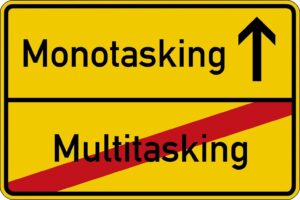 People may debate the most effective and efficient path to productivity.
However, the debate between monotasking and multitasking is more than a matter of preference; it is about optimizing our mental resources and caring for our brains.
While multitasking can seem like a way to handle more in less time, it often leads to inefficient work habits, leaving you feeling overwhelmed and unproductive, as you spend more time fixing errors than making progress.
Embracing monotasking allows us to focus intensely on a task and produce higher-quality work that showcases our full potential.
Researcher Jesper Aagard said, “Multitasking is functionally equivalent to distraction.” We should pause and consider his words. What would happen if we all slowed down and focused on one thing at a time?
By: Sandra Hartley
January 2026