
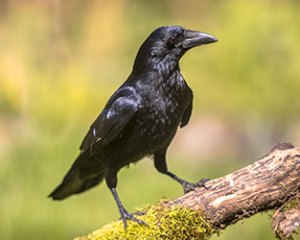
 The Watchful Crow
Here in Clay County, where the woods meet open fields and expanding neighborhoods, crows have adapted easily, studying our routines, remembering our faces, and thriving alongside us. They hold grudges. They bring gifts. They mourn their dead. Meet the clever birds perched on power lines, watching us with quiet calculation.
A Crow’s Calling Card
Crows are among the most fascinating and intelligent birds in the world. Known for their sleek black feathers and haunting calls, they have long been associated with mystery, folklore, and symbolism. Beyond their striking appearance and cultural significance, crows display remarkable behaviors and cognitive abilities. These birds are more than mere survivors in the animal kingdom; they are innovators, problem solvers, and social animals whose complexity rivals that of some primates.
Outsmarting the Odds
Crows aren’t just smart birds; they’re intelligent overall. With brain-to-body ratios comparable to those of primates, they excel at tool use, delayed gratification, and understanding cause and effect. In one example, a crow bent a wire into a hook to retrieve food—without any training. Another crow solved a complex, multi-step puzzle that stumped most children.
It’s common to see crows in traffic, but some aren’t just crossing; they’ve learned to drop nuts at intersections so cars crack them open. They don’t just drop and leave them; they wait for the light to turn red, then swoop in for the snack. That’s not instinct. That’s strategy.
Crows even hold grudges. In a well-known study, they remembered a masked researcher who had trapped them and held a five-year grudge, complete with scolding calls and coordinated attacks. The crows hadn’t just remembered—they’d told their friends, too.
 Social Architects
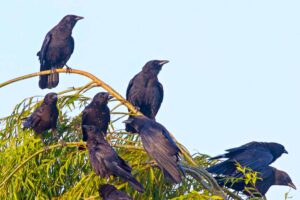
Crows are highly social animals that live in tight-knit communities. They form lifelong pair bonds, raise their young together, and even speak in regional dialects. Juveniles often stay with their parents to help raise their younger siblings, much like a feathered apprentice in a family business.
When one of their own dies, a gathering of crows circles the body, silent and still. Scientists debate whether these are funerals, warnings, or investigations—but the behavior is unmistakably social. Something is felt. Something is shared.
They also provide each other with comfort. If one crow is upset, others might approach and touch beaks or preen—gestures that express empathy.
Masters of Adaptation
Crows thrive in cities, forests, deserts, and farms. They eat almost anything, learn quickly, and exploit human routines. In some neighborhoods, they remember garbage pickup schedules better than residents do.
Their flight is purposeful—steady flaps, squared-off tails, and a voice that cuts through the air: caw-caw-caw. Up close, their beaks are straight and sharp, and their eyes are dark and curious. They don’t just pass through the world—they study it.
The Gift Givers
Some crows leave tokens for the humans they trust: buttons, beads, and bits of foil. It’s not random; it’s recognition—a shiny thank-you for the kindness shown.
A Place in Lore
Crows play a distinctive role in world mythology. In many Native American traditions, the crow is a trickster—intelligent, mischievous, and often a symbol of transformation or sacred gifts such as fire. In Hindu belief, crows are linked to ancestral spirits, and offering them food is considered a way to honor ancestors. In Japan, the three-legged crow, Yatagarasu, serves as a divine guide, representing wisdom and heavenly direction.
A Place in Pop Culture
Crows have also become a staple of popular culture, especially around Halloween. From the cult classic The Crow (featuring a crow-inspired character) to spooky flocks in Jeepers Creepers 2 and Children of the Corn, these black birds often symbolize fear and mystery on screen. They haunt the fields of Sleepy Hollow and appear in horror games like Resident Evil, cementing their role as ominous guardians. Even in Halloween decorations, perched on scarecrows or grave markers, crows remain a lasting symbol of the season’s darker side.
Maybe it’s their intelligence. Perhaps it’s their jet-black feathers and inquisitive gaze. Whatever the reason, crows keep appearing in our stories—just as they keep showing up in our neighborhoods. Beyond myth, their sharp intelligence is undeniable: crows can mimic human speech, adding to their air of mystery and their connection to the human world.
Next time a crow watches you from a wire, remember—it might know you better than you think. Don’t just look away. You’re being watched, maybe even remembered. If it leaves you something shiny, take it as a compliment. That’s crow-speak for “I like you.”
By: Sandra Hartley
January 2026
Observation